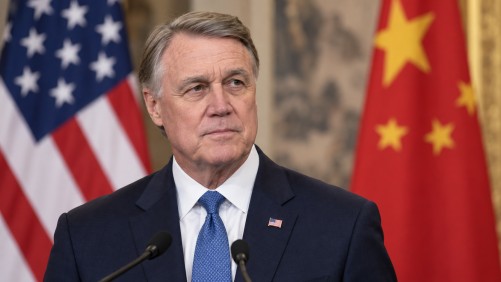
Following the recent summit between Chinese President Xi Jinping and U.S. President Donald Trump, U.S. Ambassador to China David Perdue has expressed concerns about the future of U.S.-China relations. Despite the positive diplomatic exchanges during Xi’s three-day visit to the United States, Perdue warned of ongoing challenges, particularly in reducing America’s reliance on China for critical supplies.
Perdue highlighted the United States’ dependence on China for essential materials such as rare earth elements, magnets, pharmaceuticals, and commercial shipbuilding, describing this situation as untenable for national security. His remarks underscore the U.S. government’s strategic goal to diversify supply chains and mitigate potential disruptions.
During the summit, Xi and Trump reached several economic agreements and pledged to continue dialogue on various issues. However, significant differences remain between the two nations, including contentious topics like Taiwan, technology, trade, and Iran. While China promoted the summit as a step towards a more constructive and stable relationship, Xi acknowledged that challenges and disagreements would persist.
The U.S. has been actively pursuing ways to lessen its exposure to China’s dominance in strategic supply chains, particularly in sectors crucial for defense, automotive, electronics, and renewable energy industries. These efforts are part of a broader strategy to safeguard U.S. interests and maintain economic resilience.
Despite the diplomatic engagements and commitments made during Xi’s visit, Perdue’s comments reflect ongoing tensions and the complex nature of U.S.-China relations. As both nations continue negotiations, the path forward is expected to be fraught with difficulties, signaling a potentially bumpy road ahead in bilateral relations.